MOBILITY INTERACTION / 2025
DEV
Keep the road
in the conversation.
Designing attention-aware interactions for delivery riders—across a phone, a helmet HUD, and voice.
Explore the case study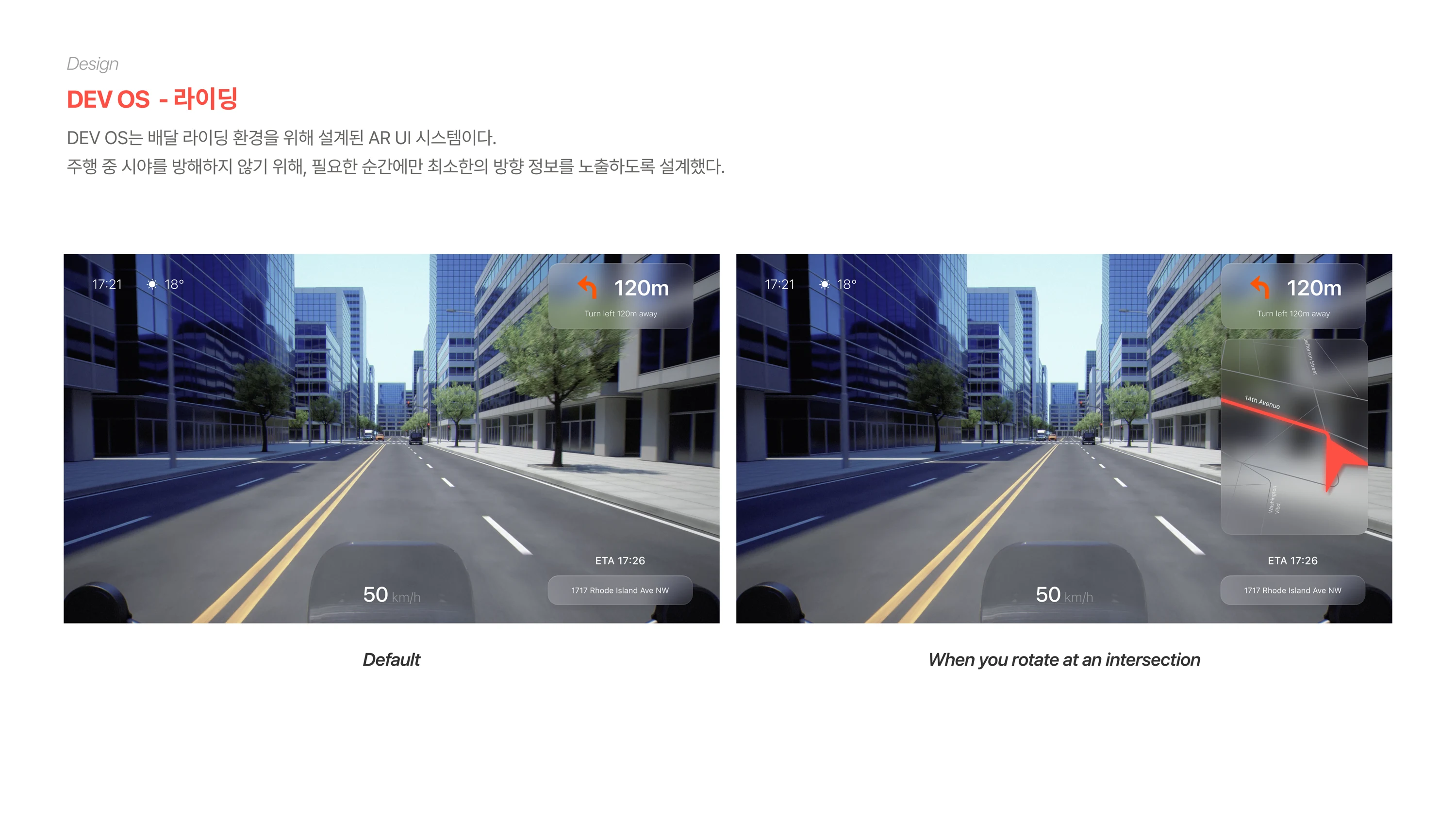
01 / FROM DELIVERY WORK TO A DESIGN QUESTION
One rider.
Two places to look.
Both designers worked as delivery riders. That experience brought a recurring conflict into focus: the phone asks for attention while the road needs it.
How might riders interact while riding—
without looking down or reaching for a phone?
Interact by voice while riding
Touching the phone to respond
Hands-free voice interaction
Let riders respond to the device through speech while keeping their hands on the handlebars.Keep navigation in view
Looking down at phone navigation
Guidance through the helmet HUD
Bring directions into the rider’s forward view to support attention to the road.Firsthand experience informed the framing, rather than a formal observational study. These design moves are hypotheses about interaction, not demonstrated safety improvements.
02 / INTERACTION ARCHITECTURE
Prepare on the phone.
Ride with HUD + voice.
During the ride, voice supports hands-free responses and the HUD brings navigation into view. The phone handles setup before the ride and review afterward.
Prepare
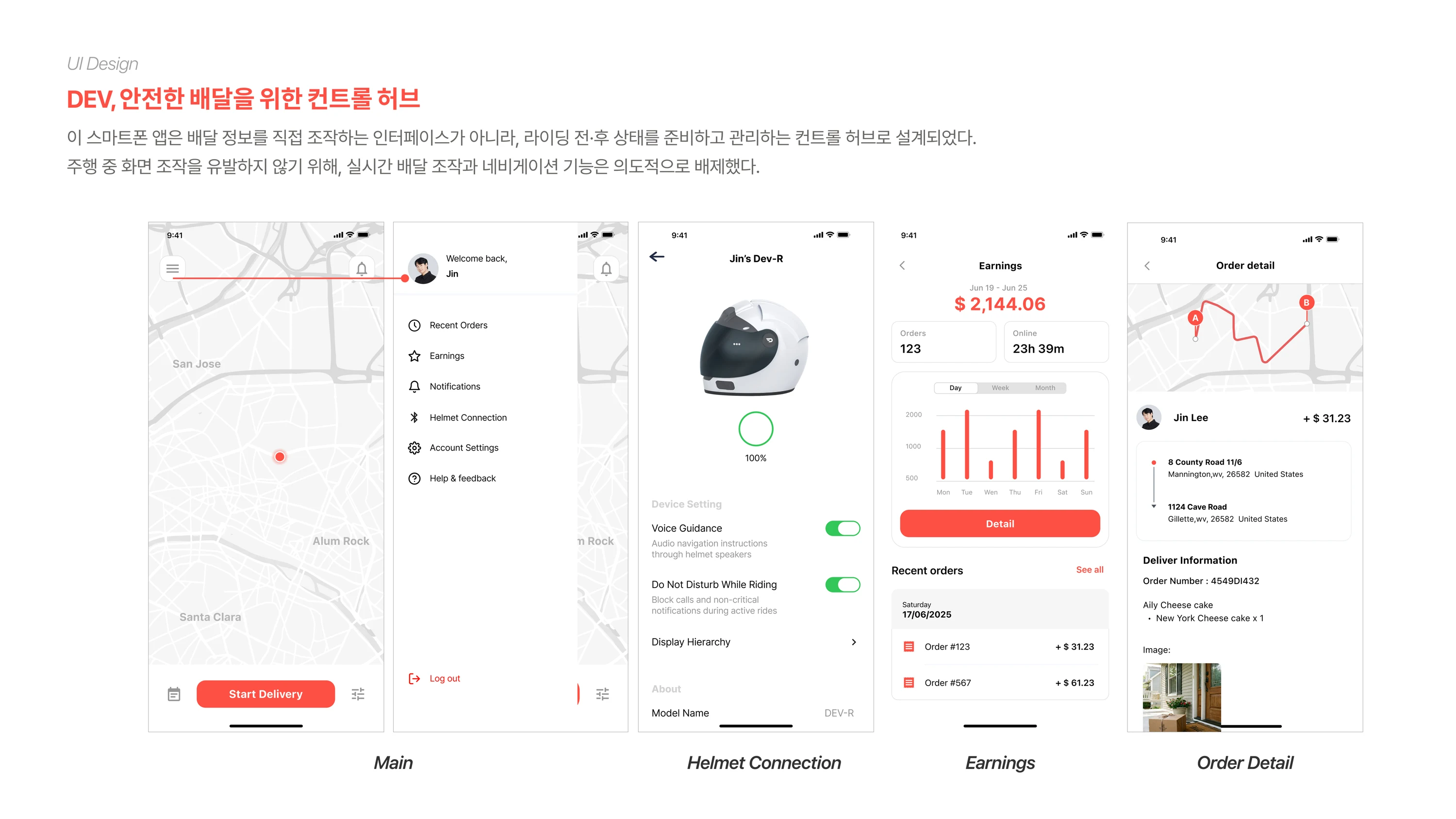
- Connect the helmet
- Set guidance preferences
- Start the session
Navigate + respond
- Follow the next-turn cue
- See context at intersections
- Respond to selected prompts
Review
- Review earnings
- Check completed orders
- Manage the next session
A spoken response removes the touch action. The order still asks for a decision.
How the project’s scope evolved +
Early exploration · Week 4
The initial presentation proposed an electric motorcycle and XR helmet, with form studies, technology references, branding, and a companion app among the planned outputs.
Final direction · Fall 2025
The exhibition brought together helmet and scooter display models, a VR riding experience, and supporting interface presentations. This case study focuses on the interaction design across the phone, helmet, and HUD. The physical models communicate the product concept; they do not demonstrate working vehicle or protective hardware.
03 / THE FINAL INTERACTION DESIGN
Different moments.
Different interfaces.
A preparation surface, a contextual riding interface, and a physical device that brings them into one concept.
A control hub for stopped moments.
Setup, settings, and history stay on the phone. Riding navigation moves to the helmet.
Change the information with the situation.
Start with the next action. Add route context at an intersection. Compare what appears—and why.
Original concept screens · Select a scenario to compare information states. This is a walkthrough, not a working helmet simulation.
Four moments inside the visor.
Explore the original interface studies: how navigation, delivery, media, and messaging occupy the rider’s field of view.
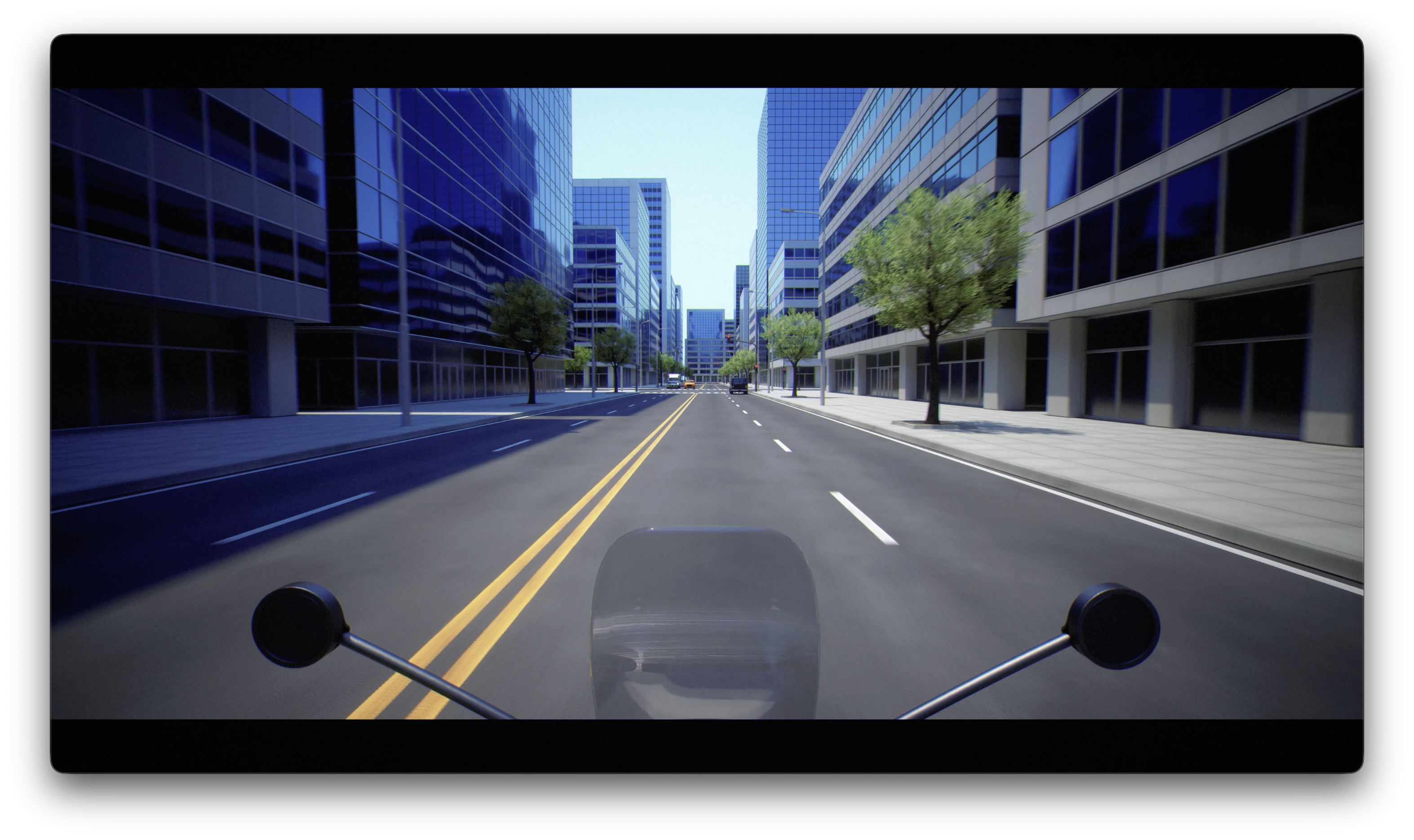















A new order enters the view.
Pickup location, distance, and expected earnings sit together. The music card shows how another service might share the same visual field.
Which information should make room for an order?
Original UI studies · Media and messaging explore a broader scope than the final concept shown above.
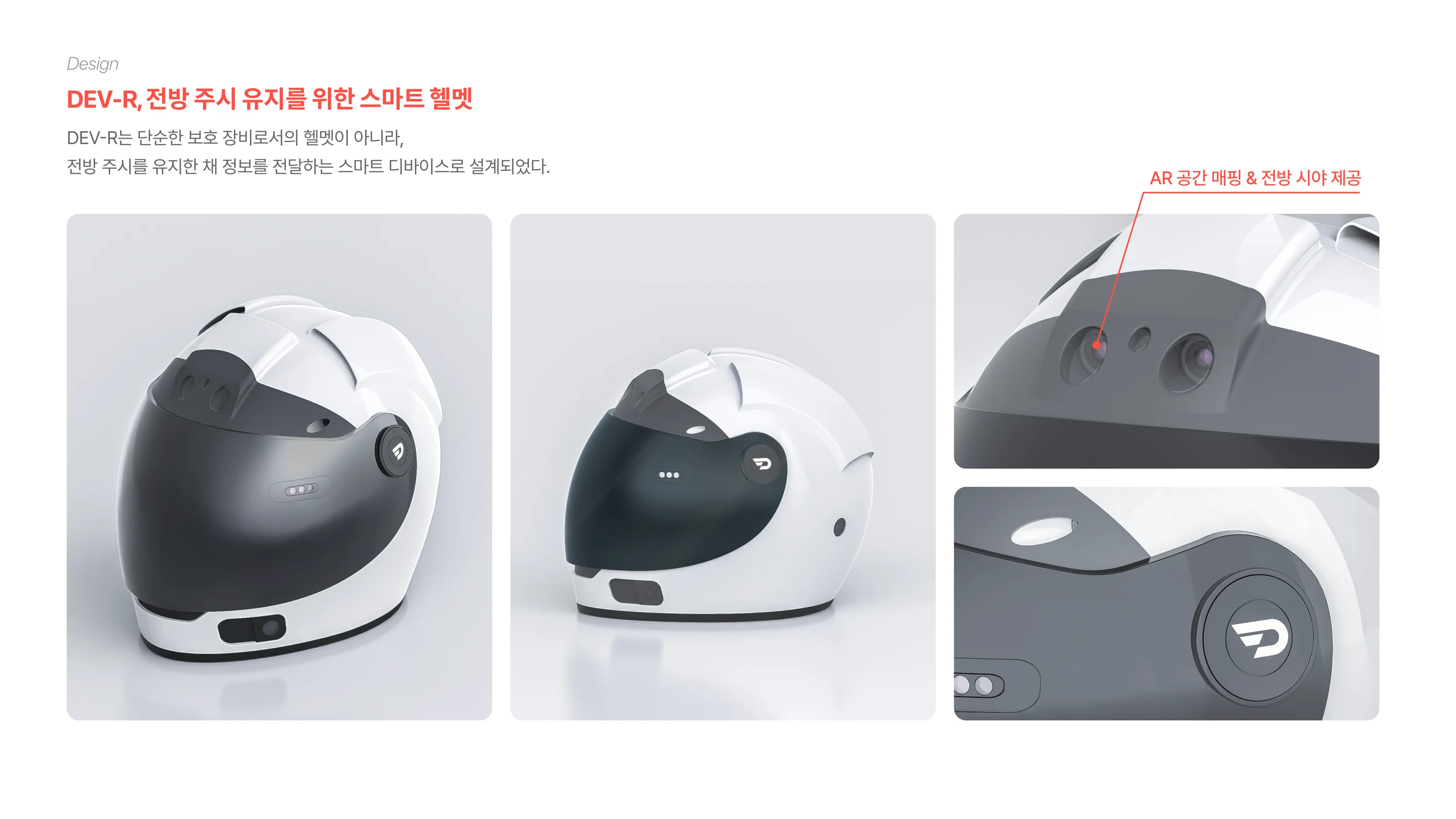
The helmet is an interface location.
DEV-R gives the interface a physical location: a visor for guidance and integrated sensing. Hardware feasibility and protective performance remain untested.
DEV in motion.
04 / EXPLORATORY XR EVALUATION
Which placement
was easier to read?
Three delivery-experienced riders compared two simulated UI distances while looking forward. ShapesXR supported an initial choice about placement.
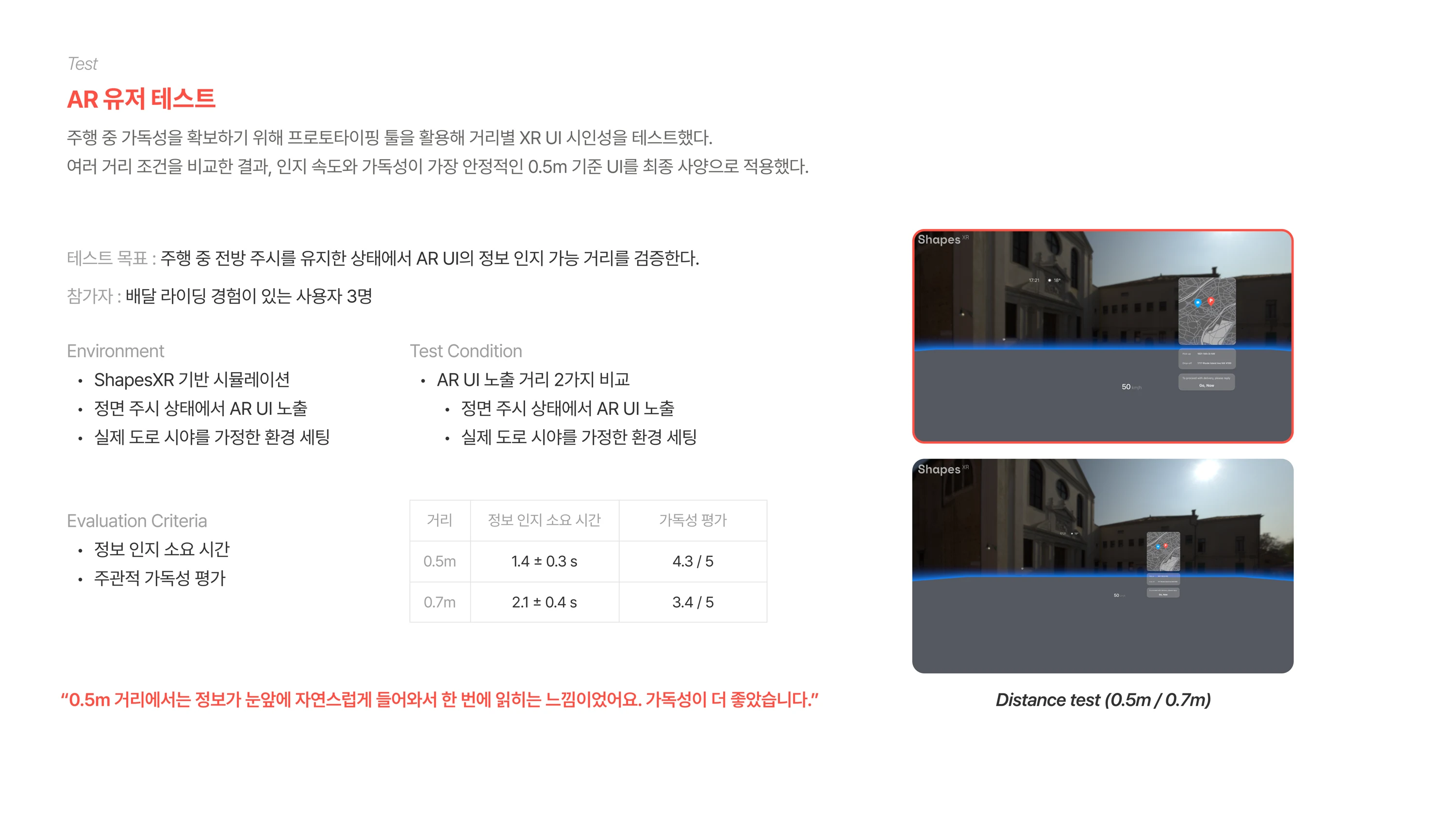
Recognition time
Seconds · shorter is better
Readability
Rating out of 5 · higher is better
Selected for the final simulated UI.
Small sample · Simulated riding · No demonstrated reduction in accidents or cognitive load.
Study details & limitations +
Participants had delivery-riding experience. The measures were information recognition time and subjective readability. My study documentation does not include trial counts, condition order, raw observations, statistical testing, or a definition of the reported ± values. The results describe this exploratory simulation; they do not establish an optimal optical distance for a real helmet.
05 / IN THE EXHIBITION
DEV, on display.
06 / REFLECTION & NEXT QUESTIONS
Attention depends on
when a system asks for it.
DEV shifted my focus from designing an individual screen to deciding which interactions belong on each device—and at which moment they should appear.
When voice fails
Explore how to defer or recover from an unrecognized command without requiring a phone interaction while moving.
When to stay quiet
Test whether incoming orders should be postponed during demanding riding situations, and how riders understand that delay.
Beyond readability
Use controlled riding simulations with more participants to study glance behavior, hazard detection, workload, and errors before considering road trials.
Placing information in the field of view is only a starting point. An attention-aware system must also decide when information deserves to be there.
Back to selected work